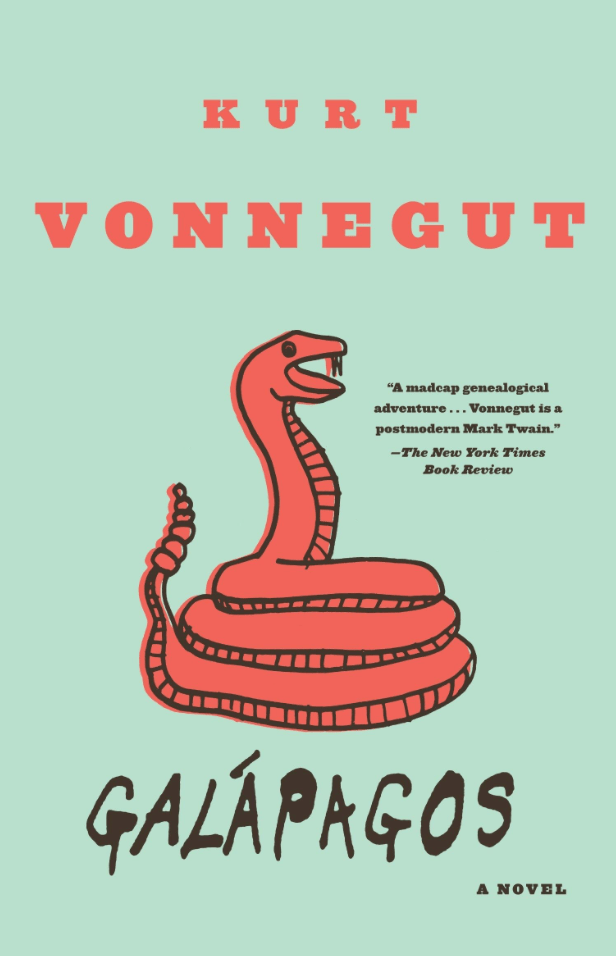
What happens in Galapagos?
Well, there’s an apocalypse. But this event takes up maybe a paragraph of text in the entire book. The dropping of devices from airplanes that are designed to destroy as many creatures as efficiently as possible takes a more prominent role in the story, but that is also not what the story is about.
There is a world-wide economic depression, where make believe things like stocks and bonds and fiat currency suddenly become worthless. Many people starve because these make-believe things suddenly lose their meaningful qualities. There are murders, and love interests. And all these things dominate the story’s wordcount, though none of these things are what the book is about.
In classic Vonnegut style, a story somehow unfolds without one being told, with dark satire all along the way.
The theme is this: Human beings are too smart for our own good. Our big brains cause all kinds of misadventures. For example, we know we should probably do something about the environment, but we would rather hit a tennis ball back and forth, back and forth, and so on. Or the time we dropped an atom bomb on Moto Mosoro, mother of two.
None of this is an issue anymore, writes the narrator, since The Law of Nature has reduced the size of our brains to much more manageable sizes. We no longer imagine things that have yet to come to pass. We no longer destroy the environment. We no longer commit suicide. Our population is easily balanced out by our being eaten by great white sharks and killer whales whiles we attempt to eat fish. And when fish populations fall, so do our populations. As it turns out, fish is all we eat one million years from now, catching them with our elongated snouts, being propelled by flipper-like hands, and such. Evolution is quite remarkable. This quote might summarize the book: “Thanks to their decreased brainpower, people aren’t diverted from the main business of life by the hobgoblins of opinion anymore.”
The narrator is writing one million years in the future. The year 1986 is when the book takes place. The narrator is a ghost, Leon Trout (1946 – 1,001,986 AD) son if Kilgore Trout, the prolific and inconsequential science fiction author. Leon became a ghost by refusing to go down the long blue tunnel after being decapitated while building a great big warship. This warship, it would turn out, would in 1986 house the last people on earth. This ship would hit land and sink at the Galapagos Archipelago. Humans would never again live anywhere else. The rest of the human kind had been ravished by an apocalypse. No other creatures were harmed in the making of this particular apocalypse, and in fact all other creatures probably faired quite well in its wake.
Note: There is the biological inquiry from our illustrious narrator Leon Trout of how remote volcanic islands came to have any creatures that could not fly a long way, or even fly at all. Like iguanas, or cormorants, or finches, or blue-footed boobies. This is a question many an American middle-schooler has stumbled upon. One theory holds that natural land rafts of vegetation carried these critters there. Well, Leon was on this island for one million years and not one such raft arrived.
The book itself is disorienting, as any good science fiction book is, and all Vonnegut novels are. This novel continues Vonnegut’s tendency towards pacifism, always in ironic tones. Here’s a good example, this quote coming right after a hospital was bombed: “As long as they killed people with conventional rather than nuclear weapons, they were praised as humanitarian statesmen. As long as they didn’t use nuclear weapons, it appears, nobody was going to give the right name to all the killing that had been going on since the end of the Second World War, which was surely “World War Three.”
As for characters, they might be described as ideas instead. Read a Steinbeck novel, like Cannery Row for instance, and you feel like you just might see Mack and the boys out on the town and go give them a hug. (This is unlike Hemingway, where no hugs will be given. Being a character of Hemingway is perhaps the deadliest thing known to humans. To quote Alicia in McCarthy’s novel Stella Maris: “When imaginary characters die imaginary deaths, they are dead nonetheless.” Quoted from memory so likely imperfect.) I did come to appreciate the characters in Galapagos, but I did not grow close to any of them.
Overall, this book was a great, fun read.
 Words and Wanderings Book Review
Leave a comment