My rating: Good – 3.5 / 5 stars
This little book was handed to me by my very good friend Nick, aka @sci_fi_up_high.
This review doesn’t include any spoilers. In fact, an important part of this review is that it would be difficult to spoil this book. It seemed to end before there was any real resolution. That this is the case must mean that the author is diving into far more than plot development.
Here are some of the things you’ll find in this book: Good versus evil; a megalomaniac personality; latent homosexuality; and spontaneous, unprovoked violence.
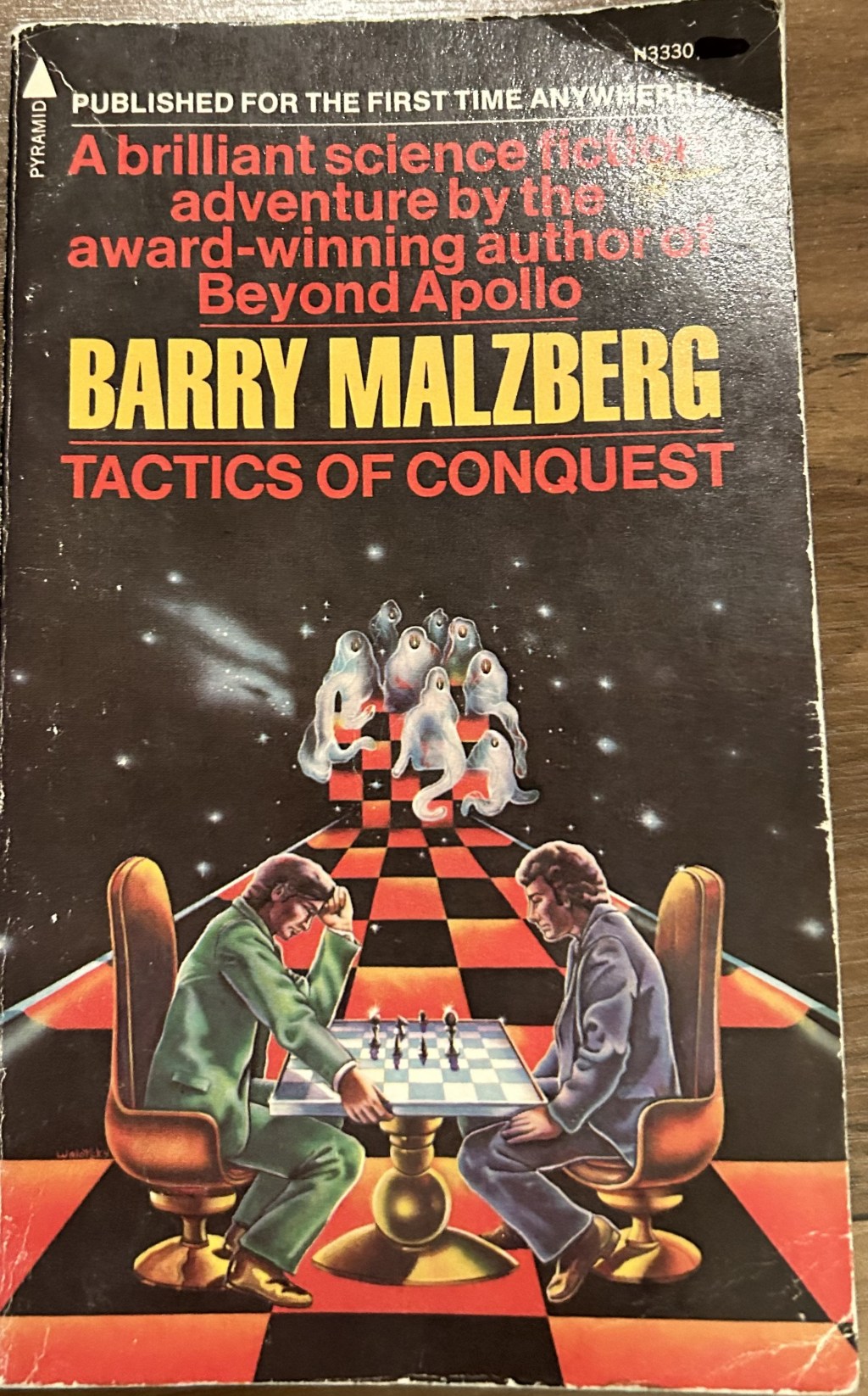
An alien race, called the Overlords, have contrived a chess match on which the fate of the world rests. These Overlords setup a 41-game series of chess matches between two grandmasters. One, the narrator named David, represents “good” and the other, Louis, “evil.” The loser is to perish, along with one-half of the world that represents either good or evil. This has many interesting themes.
One of my favorite ideas in this little book is how little the “Overlords” consider about the notion of good and evil. They express no inclination towards this duality, seeing all in singular tones. More than anything, the Overlords are concerned with what we would call the “rule of law.” “The overlords are authoritarian creatures; they take the rules of their contest quite seriously…” Nonetheless, they ostensibly hope to simplify the interactions of homo sapiens by resolving this tension once and for all.
One might see this idea through many lenses. Perhaps this relates to politics. The prevailing of good over evil or vice versa in the novel is precipitated through a game of chess. In the “real world,” it is precipitated through “games” of war, elections, imperialist economics, deployment of capital, etc.
Another is that good and evil are inextricably linked. Overlord “One” alludes himself to this idea itself. One cannot therefore be eliminated. If, arguendo, Louis lost this chess game and all that was evil was vanquished, only good would remain. But of course good is composed of degrees, and these degrees would then be pitted against one-another. Good would be at the very least bifurcated into its own good versus evil. It seems that no harmony would result from this transaction. (Though we might imagine that the net evil on the world would nonetheless be much less.)
As for the characters, you immediately feel that the protagonist/narrator is unreliable. An unreliable narrator is a favorite of mine, because they keep you on your toes. This narration style feels more like life itself: Can I trust this? Is it one sided? Is it propaganda? David is essentially a megalomaniac who overestimates his own ability and underestimates others. This plays itself out throughout the novel, which encompasses a single chess match, though with many flashbacks. For much of the novel, he obsesses about crushing his opponent, who carries a higher FIDE ranking solely because he is willing to cheat, as he believes. Alas, he ends up losing the game. An unreliable narrator, indeed.
Malzberg seems to go out of his way to sexualize anything even remotely phallic. I am honestly unsure what his purpose on this point is. It may well be that Malzberg is simply exploring themes of repressed homosexuality at a time when being gay essentially demanded a choice of either repression or social ostracism.
Chess as a game is a centerpiece of the novel. It turns out Malzberg was an avid chess player. That being true, I was a bit surprised at his lack of deep knowledge of the game. As I write this, I am struck by the realization that this idea comes from statements made by the narrator, whom I already told you was unreliable. Could it be that I have been deceived by this very narrator on this point?
My final thought on this story regards its abrupt ending. The final pages come and go, and nothing of importance seems resolved. I am no advocate of tying up all loose ends in a novel. Malzberg seems comfortable tying up no loose ends!
I found the book enjoyable, but one may not be missing out by not reading this one. I would give it a 3.5/5, or a “good.”
 Words and Wanderings Book Review
Leave a comment