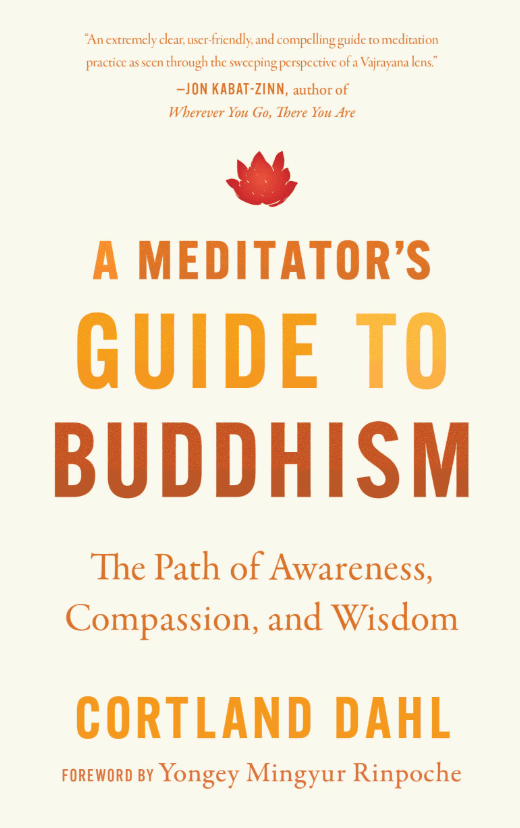
This book came to me by way of Tergar International, a mindfulness organization with which I’m affiliated. It’s CEO, Cortland Dahl, published A Meditator’s Guide to Buddhism: The Path of Awareness, Compassion, and Wisdom in 2024, replete with a foreword by the fella who is as close to a “guru” that I have: Yongey Mingyur Rinpoche.
“Buddhism is rooted in the simple idea that you can train your mind to suffer less and flourish more.” How true! Though I might say it differently having followed the train of thought throughout this book (and incorporating several years of Buddhist meditation): Buddhism is rooted in the simple idea that you can find harmony within your internal and external environment. Simple idea, tough practice. However, you see it, you will find clear guidance in this little book!
So, why did Dahl, a scientist, Buddhist scholar and translator, leader at the Center for Healthy Minds (Madison, WI), and CEO of Tergar International (busy indeed) take the time to write this book? Because he saw a gap in the psychological growth of his audience. “Mindfulness” teachings abound on Youtube, social media platforms, local yoga studios, etc. But what is Buddhism? Is it a religion? A lifestyle? (Is there a difference?) How does it related to mindfulness? And, most importantly, how do I step into Buddhism?
And this last is the point of the book. Dahl maps out the key tenants of Buddhism and where a meditator can start to learn about the Buddha’s teaching. My favorite aspect of this book – what really separates it from others, is his clear explanation of the different “vehicles” or schools of Buddhist thought and teaching. He explains the Foundation Vehicle (i.e., the Therevada Tradition typical of South-East Asian Buddhism), with its strict teachings and practices. The Great Vehicle (i.e., the Mahayana Tradition typical of China, Japan (Zen may be considered a branch of the Great Vehicle), Korea, and even Buddhism in the United States), which focuses on cultivating compassion more than practice. Lastly, he explains the Vajrayana Vehicle of Tibetan Buddhism.
Unique of the schools of teachings because of it severe geography, Tibet developed a unique Buddhist practice which is a blending of the Foundation and Great Vehicles plus many beautiful nuances. Being a disciple of Mingyur Rinpoche, a great Tibetan Buddhist teacher, Dahl is particularly fond of the Vajrayana, describing it as a culmination of Buddhist thought and practice into one set of teachings.
In describing these vehicles, he explains the pillars of Buddhism: The Four Noble Truths and the Eightfold Path, encouraging us to begin our journey on the Buddhist path with the understanding gleaned through this wonderful little book.
 Words and Wanderings Book Review
Leave a comment